Reviewed by Ben Winderman

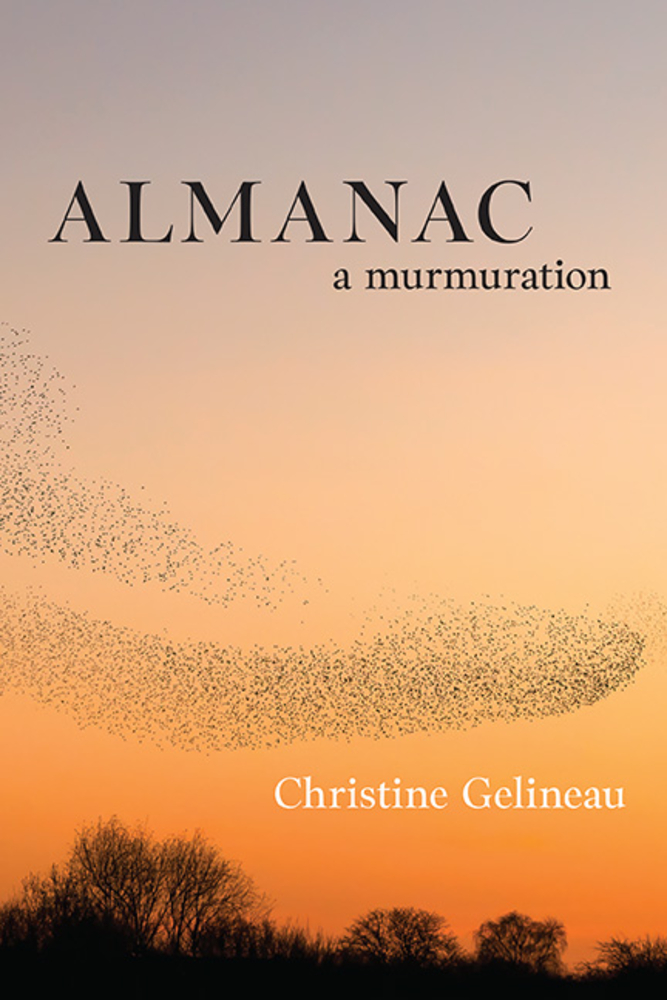 Christine Gelineau’s newly published book Almanac: A Murmuration (Excelsior Editions State University of New York Press, 2025) is a distinctive collection of 12 essays, each titled by and tethered to a month of the calendar year.
From January through December Gelineau gallops through pastures of plenty and plenty of problems: growing up with alcoholism, living with Long COVID, calibrating the calamities of climate change, and challenging the mythology of our national narratives to name a few.
The severity and sprawl of what Gelineau tackles threatens to overtake of her literary landscape, like the invasive vines of Rosa multiflora, but Gelineau is a gritty gardener. She clips/writes/lives through seasons of chaos and emerges with a steadfast determination to tell true stories.
Although Almanac resists traditional categories of genre, its eclectic essays collectively read like a memoir. Ambitious in scope Almanac’s content spans from early American colonization through COVID, but it’s Gelineau’s personal narrative that captivated this “dear reader’s” heart.
“I have an early memory,” Gelineau writes, “of my family out for a Sunday drive —that was a thing then, a Sunday drive. I’ll come back to my mother soon, but for now I’m remembering my father pulling the car to the side of the road so Christine could see the horses grazing in pasture.” In one sentence Gelineau foreshadows her troubled relationship with her mom, celebrates her dad’s penchant for taking Sunday rides to the right places, and introduces her lifelong passion for Pegasus (horses).
Sidenote 1: If you’re a fan of the television series Mad Men you’ll savor the scenes from Christine’s childhood through her college years: “Ladies Home Journal arranged on the coffee table” for ‘Bridge Club;’ the pressure on her parents to keep up appearances; “when did coffee give way to Manhattans?”
As an undergrad at UConn Gelineau knew she wanted to write. She studied Edna St. Vincent Millay, Ezra Pound, and Sylvia Plath, whose poems “packed a punch.” Her path to professional poet however was obscured by horses and pragmatism. After graduating with a degree in English she ditched her drug dealing boyfriend Alex, landed a summer job teaching horseback riding at a summer camp in the Susquehanna River valley (NY), and married the camp’s owners’ son Steve. She wrote poetry privately, bred and trained Morgan horses with her husband, had two children, learned farming and flora, and kept the pilot light lit for her writing life. In her late 30s Christine crossed paths with Bonnie Culver, a playwright, and their friendship became the catalyst for Gelineau’s enrollment in Binghamton University’s School of Creative Writing. Publications and academic posts followed, but each achievement took patience and plodding.
Sidenote 2: If you’re an aspiring writer you’ll find inspiration in Gelineau’s pasture to page career, and if you’re a woman you’ll recognize the shit piles that stood in her way. Almanac is a simultaneous celebration of Christine’s writing career and the natural/rural life that she loves: Each bloom upon the lilac a lantern of perfection: scent, color, texture, and form; the joy I felt to be on the farm in Windsor, among the horses and Steve; the Haudenosaunee method of growing Three Sisters: corn, beans, and squash.
Although her talent and persistence were eventually rewarded, neither professional accomplishment nor personal stability secured a comfortable life. Beginning in her early 50’s a sudden aneurism (brain bleed) became the opening salvo to a series of severe medical traumas that would debilitate and almost destroy her. Gaslit by her doctors and isolated by her circumstance she began to question “the stories we tell ourselves.” In Almanac these traumas change Gelineau’s voice from April’s elegance to October’s elegy. She confronts her own fiction, examines her mother’s hidden alcoholism, and flays the mythology of our original national narratives. Her determination to find truth coincides with her desire to heal, and she writes as if her/our survival depends upon this work.
Sidenote 3: If you’re a fan of John Smith, John Winthrop, or Karl Rove be careful; Christine Gelineau is coming after your assumptions. She takes aim at the patriarchal exploitation of Pocahontas, and she flays the farce of the “Pilgrims and Indians” Thanksgiving. “Untold stories may be suppressed by the principals, or prevented from being told by the powerful who prefer a different story.”
In the depths of Long COVID Christine sleeps, “cocooned in a soft blanket with encouraging mottos — courage, peace, energy, hope, resilience — sent by a friend.” She wants to believe in these things, and as readers we believe for her. But there are moments in Almanac when neither of us feels sure. “Truth telling,” she writes, “is the most impossible of language’s uses to achieve… and yet, the attempt to do so anyway, is language’s principal nobility.”
Gelineau recovered, albeit slowly, from long COVID. Sidenote 4: If you’re interested in non-western medicine, acupuncture in particular, you’ll relish in reading her account. When soon after she sustains a traumatic brain injury in a horse-riding accident, the only hero we have left is her “blessed” riding helmet. As readers we stick with Christine through these traumas, because she doesn’t hide her devastation; she doesn’t keep up appearances.
Eventually the doctor in charge of her case told her, “You’re a young woman with an old birth certificate.” And Christine chose to listen. “Children home in on the details,” she writes, “that validate what they are most famished for. Perhaps that’s what we all do with stories. Incorporate what we’re famished for.” I was famished for this book, these stories. I devoured it. The memories of her parents were most powerful for me: “The mother I remember from my childhood was formidable: strong-willed, able and dependable, tender and terrifying, talented, demanding, sensitive, productive, passionate, unpredictable, admirable, and yes, at times pathetic.” One of Gelineau’s greatest talents is that she tells it like it is. As a writer I know that’s more difficult than it appears to be.
Almanac is a challenging climb, but mountain vistas are always more breathtaking when you’ve hiked the ascent. Gelineau doesn’t offer a direct and effortless tram to the summit. There are thickets to trudge and wetlands to portage; there are mean girls, brain bleeds, and a heart wrenching $20 bill goodbye. There are petals, claws, paws, and hooves; it’s a memoir of scent, scruff, and saddle.
Two of my favorite cameos are Missy the “whip-smart” Sheltie who she and her dad pick up on a Sunday drive, and Jock the 3-legged beagle who helps Long Covid Christine to “get on with it.” Gardens and good dogs take a back seat however, to horses in this tale. Reading about how horse and rider become one, indistinguishable in the duality of movement and motion, was beautiful: “At its best,” Gelineau writes, “I understand horseback riding as a preverbal, interspecies ‘language’ that is spoken with the whole of the body, a kinetic poetry that the ‘poet’ and the ‘poem’ create together.”
I love Christine Gelineau’s authentic sense of self; she sticks with what/whom she loves. I love her loyalty to the truth and her pursuit of it through language. I love her fierce determination to feel better. I loved sitting at my kitchen table with her book and black coffee, looking up from the page to ponder. I loved marking up many pages with notes, and circling words I’ll never use. I laughed out loud when she discussed “the allure of manure” in growing roses with her Uncle Oscar, and I cried for the loneliness of her “hollowed eyes.”
One has to be able at every moment to place one’s hand on the earth like the first human being.
Christine Gelineau’s Almanac is that moment, that first human hand to the ground. Like Rilke’s quote, which came to this author “free-floating,” and is permanently tacked to the wall over her writing desk. Theodore Roosevelt claimed, “Comparison is the thief of joy,” and indeed, I have little to compare Almanac with. Perhaps Pam Houston pulled off a similar feat with her “novel” Contents May Have Shifted. Houston assembled 144 vignettes and told a chronological story in a non-linear way. Both Gelineau and Houston utilize non-traditional methods of storytelling, both push-away sentimentality, and both embrace the “un-spoiled” callousness of nature.
It’s hazardous to examine your past while simultaneously living through a grueling present. It’s difficult placing one’s hand originally on the earth. Portraying life’s chaos in a concise manner is a literary feat. Christine Gelineau is a helluva writer, and Almanac is her masterpiece.
 Ben Winderman is a writer from Bucks County, Pennsylvania. He won the New Millenium Writings Nonfiction Award for his essay “Ladders,” and has published work in The Dying Goose and as a soccer journalist for www.suburbanonesports.com. He’s working on a full-length memoir entitled Going to the Dogs. Ben earned his MA from the Wilkes University Maslow Family Creative Writing Program. He has two grown children (Sam and Maggie) and one sweet boxer (mix) named Sasha.