
Every day, it started the same way. I logged on to Word. I saw the request from AI: press this button and we’ll draft your work for you with Copilot. I closed my computer, ran my hand through my hair, uncapped my pen and wrote.
When I sit at my desk, hands hovering over the keys, about to type, I feel paralyzed by the many forces that are telling me that my career, my life’s love, doesn’t matter. That the original words of a human being are only as good as being part of a collective slew of sources, which generates repetitive, uninspired phrasings under the name of AI.
My memoir, which the editors at University Press of Kentucky are currently reading and discussing, tells of my journey with schizophrenia. With writers like Esmé Weijun Wang as my guide, I felt, before AI, as if I was entering into a kind of legacy. Now, AI seems to suggest that the role of the author is obsolete.
However, authors like Wang are the ones who inspire us to write. They inspire us to find a home in writing, among like-minded artists who had to suffer through pills that caused our facial features to spasm and twitch, and who hallucinated like I did — faces in the walls, shadows, that made my stomach lurch, but when I reached out to touch them, to talk to them, it was only the wall. A slab of dirty white. I was alone, completely, tethered to a mind that lied.
The makers of AI don’t care. They’ll sacrifice spirit for efficiency, unaware that before I found writing, before I got the proper care, a psychiatrist asked to look in my bra and panties. “I’m your doctor,” he told me. “I need to look,” after repeating to me how beautiful he thought I was, how I might expect to see him in the neighborhood, by my house. He made me feel that I was empty, a dirty skillet scraped, and for years I thought that I was nothing more than a body.
When I entered Goucher College’s MFA program, and I began writing my memoir-in-essays, I felt the strength of my own mind, the experiences that made me weak bubbling through my fingertips onto the keys. I sat up straighter, taller. I ate more ice cream, frozen dinners, allowing my body to take up the space it had shrunk from now that my mind was a majesty. I revisited Wang’s book, The Collected Schizophrenias. Here was a woman who had become a success because of her pain, who made me feel like I could be someone more than a pill-bound degenerate, someone other people might even read and learn from.
I even reached out to Wang at one point. She responded via an audio recording, and I remember listening to her voice on the train as I came back from a Goucher residency in New York, my headphones plugged into my ears, the side of my face pressed against the window. Against the backdrop of the train’s engine, Wang told me that she felt uplifted that her words had given me hope.
AI could never give anyone hope, consolation or confirmation that their voice matters. In fact, the very existence of AI tells people like me, people like Wang, that our personal experiences are about as relevant as tissue paper fluttering to the ground, soon to be stamped out by the bottom of a loafer’s dirty sole.
When AI became prominent, it took over Word, and I, the person who had sat queenly before her keyboard, bun high in the place of a crown, now sat rigid, heart beating, fingers frozen in mid-hover above the keys.
Fuck it.
I slam my computer closed, put it where I can’t see it, under some reusable grocery bags and half-finished paintings. I put a jar with my cat’s scabs front and center on my desk, open my composition notebook, and tell myself it doesn’t matter. Get something down, even if it’s shit.
I take a moment and stare out my window, at the expanse of green that hides and masks the deer that were so prominent in winter. Opening a window, I smell sweet honeysuckle. My ginger cat nestles into my lap, purring, and I watch as he climbs onto the computer, and lies his body longways atop the cool metal.
And I realize that this moment of peace after the panic is worth more, is much bigger, than the assignment at hand.
And once I give myself permission, I can let the breath go that felt clogged in my ribs.
I pick up my pen, something with dark ink, and begin to write.
My handwriting is loose and big, and often indecipherable by people other than me who try to read it. It fills up the page frantically, similar to how back when I was manic, words pushed and tumbled from my lips. There’s this part of me, creativity, that AI, that medication, can’t stifle. I won’t let it.
Virginia Woolf — the original exalted madwoman — also wrote her first drafts by hand. According to Ellen Gutoskey of Mental Floss, Woolf wrote with purple pen, and I imagine that after her writing sessions, her hands were covered in purple ink.
My own pen doesn’t leak, but the ink on my arms reminds me of my spirit. Her soul is lightning, blazingly untamed; there is a glowing fire flashing through her veins. A tattoo of a poem I wrote, that twines me to female writers like Wang and Woolf. Whether I like it or not, my purpose, my creativity, is sealed to my skin with ink, bound to my soul with blood. Wang, Woolf and I, we’re creative spirits, and however AI might progress or come to surpass us, it can never possess a spirit untamed. A spirit with intent. It can mimic, it can repeat, and weave something together from already existing sources, but it can never thrive. It can never conquer the threat of its own mind.
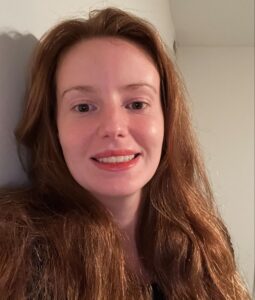 Liv Albright’s creative nonfiction is forthcoming in Permafrost Magazine, and her debut fiction piece will be published by Voll. 1 Brooklyn. Her book reviews and author interviews are published in Harvard Review, The Millions, Chicago Review of Books. Vol.1 Brooklyn, Full Stop, Electric Literature and Ligeia. Liv’s review essay for After the Art was nominated for The Best American Essays as well as a Pushcart Prize. She is a graduate of Goucher College’s Nonfiction MFA program.